

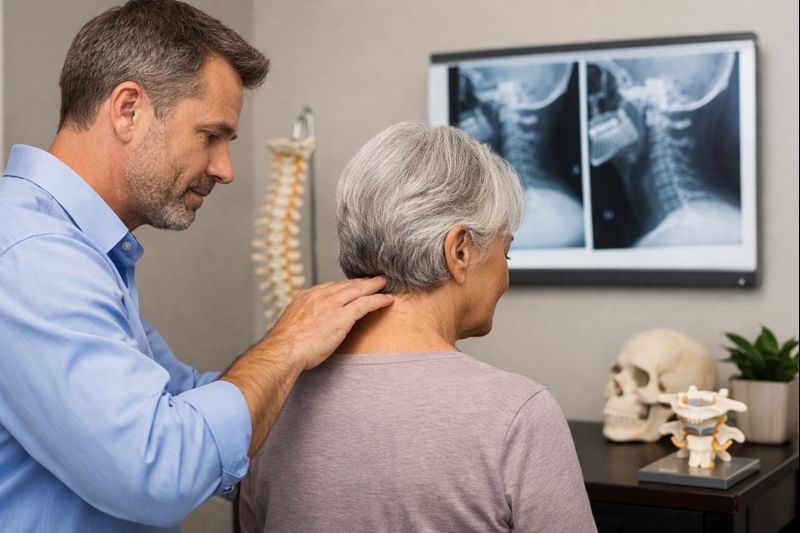
The upper cervical spine refers to the top part of the neck, made up primarily of the C1 (atlas) and C2 (axis) vertebrae.
This region supports the head, allows rotation and nodding, and protects the lower brainstem and spinal cord. Because of its mobility and load, it is sensitive to long-term mechanical stress.
What does “degenerative changes” mean?
Degenerative changes describe gradual wear-and-tear processes that occur in spinal joints, discs, ligaments, and surrounding tissues.
In the upper cervical spine, these changes often develop slowly over years rather than from a single injury.
Common degenerative processes include:
- Cartilage thinning in the facet joints
- Reduced joint space and stiffness
- Bone spur formation (osteophytes)
- Ligament thickening or loss of elasticity
These are often grouped under terms such as cervical spondylosis or degenerative joint disease, though changes in the upper cervical spine have unique effects due to anatomy and neurology.
Why the upper cervical spine is different
Unlike the lower neck, the upper cervical region:
- Prioritizes rotation and fine control, not load bearing
- Has no intervertebral disc between C1 and C2
- Sits directly below the brainstem
Because of this, even mild degenerative changes can influence:
- Neck mobility
- Head position awareness
- Muscle tone in the neck and shoulders
- Neurological signaling related to balance and posture
Related article
Sharp Pain at the Back of Your Head? Understanding Occipital Neuralgia in Roseville
Aug 05, 2026Common symptoms patients notice
Degenerative changes in the upper cervical spine do not always cause pain. When symptoms appear, they may include:
- Persistent neck stiffness, especially with rotation
- Headaches that begin at the base of the skull
- Reduced range of motion when turning the head
- Neck fatigue with prolonged sitting or screen use
- Sensation of pressure or tightness in the upper neck
Symptoms often fluctuate and may worsen with stress, poor posture, or prolonged static positions.
What causes degeneration in the upper cervical spine?
Several factors commonly contribute:
1. Postural load over time
Forward head posture increases compressive and shear forces at C1–C2, accelerating joint stress.
2. Repetitive micro-stress
Daily activities such as desk work, phone use, or driving place repeated low-grade strain on the upper cervical joints.
3. Previous trauma
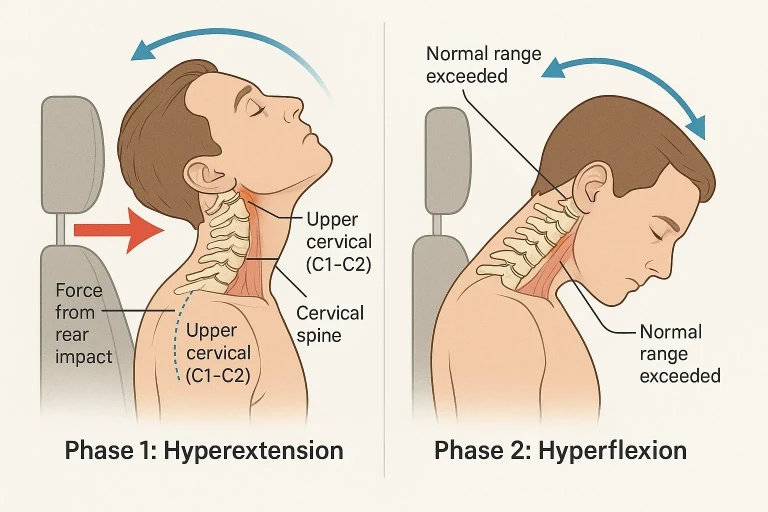
Past injuries such as whiplash or falls can alter joint mechanics, even if symptoms resolved years earlier.
4. Age-related tissue changes
With age, cartilage hydration and joint resilience naturally decline, making tissues less tolerant to load.
How degenerative changes are identified
Degenerative changes are usually identified through:
- Clinical examination (motion testing, palpation, symptom patterns)
- Imaging such as X-ray, CT, or MRI when clinically appropriate

It is common for imaging to show degenerative findings even in people without symptoms.
For this reason, findings are interpreted alongside clinical presentation, not in isolation.
What research shows
Scientific literature supports several key points:
- Degenerative changes in the cervical spine are common with aging and increase steadily after mid-adulthood.
- Structural changes do not always correlate directly with pain intensity.
- Altered joint mechanics can affect neuromuscular control, contributing to stiffness and functional limitation rather than acute pain alone.
Research emphasizes that degeneration is often a process, not a diagnosis by itself.
Management approaches patients often explore
Care strategies typically focus on function rather than “reversing” degeneration.
Common goals include:
- Improving joint mobility and controlled motion
- Reducing unnecessary mechanical stress
- Supporting posture and ergonomic habits
- Addressing muscular imbalance and coordination
Conservative care is often emphasized first, with imaging and specialist referral used when neurological signs or progressive symptoms are present.
When to seek further evaluation
Additional evaluation may be recommended if symptoms include:
- Progressive weakness or numbness
- Significant balance disturbances
- Severe or worsening headaches
- Symptoms following recent trauma
These findings require prompt clinical assessment.
How upper cervical chiropractic care may help
Upper cervical chiropractic care focuses specifically on the alignment and movement of the C1 (atlas) and C2 (axis) vertebrae.
The goal is not to treat degeneration itself, but to reduce abnormal joint stress, improve motion, and support normal neurological communication in this highly sensitive region.
Patients with degenerative changes in the upper cervical spine often seek this approach to:
- Improve neck mobility and rotation
- Reduce mechanical stress on irritated joints
- Address postural imbalances affecting the head and neck
- Support long-term spinal function rather than short-term symptom relief
Care is typically gentle, precise, and guided by detailed assessment and imaging when appropriate.
When to consider visiting an upper cervical chiropractic practice
If you experience ongoing neck stiffness, recurrent headaches starting at the base of the skull, reduced head rotation, or neck fatigue that does not improve with rest or basic care, an upper cervical evaluation may be appropriate.
A qualified upper cervical chiropractor can determine whether joint mechanics in this region are contributing to your symptoms and discuss individualized care options based on your findings.
Scheduling a consultation allows you to ask questions, review imaging if needed, and understand whether this type of care fits your situation and goals.
Key takeaways
Degenerative changes in the upper cervical spine are common and often gradual
Symptoms may involve stiffness, headaches, or reduced motion rather than constant pain
Imaging findings must be interpreted in the clinical context
Management focuses on function, movement quality, and long-term spinal health
Leave a comment