

Lower back pain is the most common musculoskeletal complaint in America. Sciatica — the sharp, burning, or shooting pain that travels from the lower back down through the buttock and into the leg — is not far behind.
Together they account for more missed workdays, more doctor visits, and more long-term disability than almost any other physical condition.
For patients in Roseville and the greater Sacramento region, the treatment path for sciatica and lower back pain is familiar. Rest. Anti-inflammatories. Physical therapy. Epidural steroid injections. Sometimes surgery. Each step addresses the lumbar spine as the origin of the problem — because that is where the pain is, and that is where conventional treatment looks.
What most patients never hear is that the structural origin of chronic lower back pain and sciatica frequently sits at the opposite end of the spine.
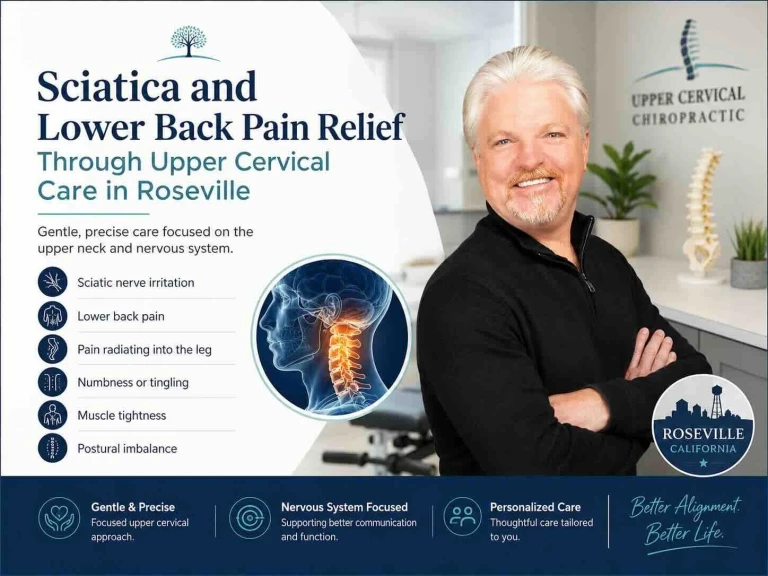
At PRC Pierce Ringstad Chiropractic on Ascot Drive, upper cervical chiropractic care is helping Roseville patients resolve lower back and sciatic pain by correcting a foundational misalignment that lumbar-focused treatment never touches.
Why the Lower Back Is Often the Victim, Not the Cause
The spine is not a collection of independent segments. It is a single integrated structure, and every part of it influences every other part. When the atlas — the C1 vertebra at the very top of the spine — shifts out of its optimal position, the entire spinal column compensates from the top down.
Here is what that compensation looks like in practice. The atlas sits beneath the skull and supports the weight of the head. When it displaces, the head tilts slightly to one side.
The brain, hardwired to keep the eyes level with the horizon, triggers a postural correction through the rest of the spine. One shoulder drops. The thoracic spine curves to compensate. The pelvis tilts. One hip rises higher than the other.
That postural compensation pattern — driven entirely by an atlas misalignment at the top — places uneven, asymmetric loading on the lumbar discs, facet joints, sacroiliac joints, and the muscles supporting them.
Over months and years, that uneven loading produces exactly the conditions for disc herniation, nerve compression, and the chronic lower back pain that sends people to orthopedic surgeons and pain management specialists.

The sciatic nerve — the longest nerve in the body, running from the lower spine through the buttock and down each leg — is directly affected by this compensation.
When the pelvis tilts and the lumbar spine is loaded unevenly, the sciatic nerve can become compressed or irritated at multiple points along its path. The result is the characteristic burning, shooting, or aching pain of sciatica that can extend all the way to the foot.
Treating the lumbar spine in isolation while the atlas remains displaced is treating the consequence without addressing the cause. The lower back will continue to compensate. The disc pressure will return. The sciatica will cycle back.
What Makes Upper Cervical Chiropractic Different for Sciatica Patients
Upper cervical chiropractic does not treat the lower back directly. There are no lumbar adjustments, no sacral manipulation, no direct intervention at the site of the sciatic pain. The entire focus is on the atlas and axis — correcting the foundational misalignment at the top of the structural chain that is driving the compensation pattern at the bottom.
This approach surprises most patients who come in with lower back and leg pain. The idea that a gentle correction at the base of the skull could reduce sciatic pain in the leg sounds counterintuitive — until the structural chain connecting them is understood.
When the atlas is corrected and the head sits level again, the postural compensation unwinds. The shoulder levels. The pelvis returns toward neutral. The uneven loading on the lumbar discs reduces.
The pressure on the sciatic nerve decreases. Patients frequently report lower back and leg symptom improvement without anyone ever touching their lumbar spine — because the structural problem driving those symptoms has been addressed at its actual source.
The Roseville and Sacramento Region Context
Roseville sits at the intersection of several realities that make lower back pain and sciatica particularly prevalent. Long commutes on I-80 and Highway 65 mean significant daily sitting time in positions that load the lumbar spine asymmetrically.
Office and desk work in the region's growing professional sector compounds that postural load. Physical labor in construction, warehousing, and agriculture adds acute and cumulative spinal stress.

Auto accidents on the busy freeway corridors connecting Roseville to Sacramento, Auburn, and the Bay Area are also common contributors. A rear-end collision that displaces the atlas may not produce dramatic immediate neck symptoms — but the compensatory postural pattern it sets in motion can produce chronic lower back and sciatic pain that develops over the following months and years, with no obvious connection to the original accident.
Many PRC Pierce Ringstad Chiropractic patients come in having managed lower back pain for years through physical therapy, chiropractic lumbar care, and pain management — with results that help temporarily but never hold. The atlas displacement sitting at the top of the structural chain has been present and unaddressed throughout all of it.
How PRC Pierce Ringstad Chiropractic Evaluates Sciatica and Lower Back Pain
The evaluation begins with a thorough health history. For lower back and sciatica patients, this conversation covers:
- The onset and pattern of lower back pain and sciatic symptoms
- Any history of head, neck, or spinal trauma — including accidents, falls, or sports injuries
- Previous treatments tried and their outcomes
- Whether symptoms are unilateral or bilateral, and whether they follow a dermatomal pattern
Precision upper cervical imaging follows. Cone beam computed tomography or detailed X-ray analysis produces a three-dimensional picture of the atlas and axis position — measuring rotation, lateral displacement, and angular deviation with a level of precision that standard lumbar imaging never attempts.
For sciatica patients who have had multiple lumbar MRIs, this upper cervical assessment frequently reveals a structural finding that explains why their lower back treatment has not produced lasting results.
Objective neurological testing provides additional data before any correction is considered:
- Paraspinal infrared thermography identifies asymmetric neurological activity along the entire spine, mapping the compensation pattern from atlas to sacrum
- Leg length and postural analysis documents the pelvic tilt and spinal imbalance resulting from the atlas displacement
- All findings are reviewed together before any adjustment decision is made
The correction itself is gentle and precise. No lumbar manipulation, no aggressive cervical adjustment, no twisting or cracking. The force is low, the contact is specific to the upper cervical segment, and the vector is calculated from the imaging data. Post-correction objective testing confirms the atlas moved into its corrected position before the patient leaves.
What Sciatica and Lower Back Pain Patients Typically Experience

Results vary based on how long the atlas misalignment has been present, the degree of disc or nerve involvement in the lumbar spine, and individual healing factors. What most patients notice in the early stages of care includes:
- Reduced muscle tension and spasm in the lower back as the postural compensation begins to unwind
- Changes in leg pain pattern — often a reduction in the distal symptoms before the lower back itself fully resolves
- Improved ability to sit, stand, and walk for longer periods without symptom escalation
- Better sleep as the chronic muscular holding pattern in the lower back begins to release
For patients with significant disc herniation or long-standing nerve compression, upper cervical care works best as part of a broader treatment approach.
Reducing the structural load on the lumbar spine through atlas correction creates a better environment for disc healing and nerve recovery — but other supportive care may be appropriate alongside it.
What upper cervical care uniquely provides is a correction of the foundational structural driver that other treatments have been working around.
When the atlas holds its corrected position and the postural compensation unwinds, the lower back is no longer being loaded asymmetrically every waking hour. That change in mechanical environment is what allows lasting improvement to develop.
Lower Back Pain Is Not Inevitable and Sciatica Is Not Permanent
A lot of patients in Roseville have been told — implicitly or explicitly — that their lower back is just going to be a problem. That sciatica is something to manage. That their MRI findings explain a future of recurring flare-ups and progressive limitation.
That conclusion deserves scrutiny when the upper cervical spine has never been evaluated as a contributing factor. The structural chain connecting the atlas to the lumbar spine is real, measurable, and correctable. For patients whose lower back pain has not responded to treatment the way it should, the top of the spine is a place worth looking.
PRC Pierce Ringstad Chiropractic is located at 115 Ascot Dr, Suite 120, Roseville, CA 95661. Call (916) 773-0200 to schedule a consultation.
If sciatica and lower back pain have been limiting your life and conventional treatment has not produced lasting results, a precision upper cervical evaluation is a logical and non-invasive next step.
Leave a comment