

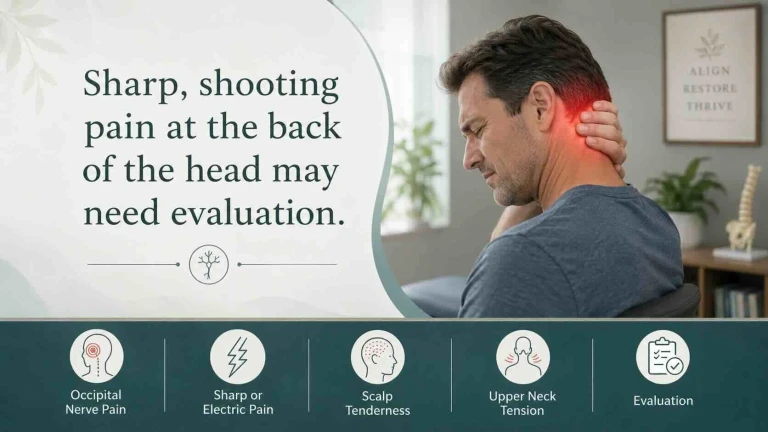
The pain can arrive without much warning.
One moment, you are driving, working at a computer, or turning your head. The next, a sharp sensation shoots from the top of your neck into the back of your scalp.
Some people describe it as an electric jolt. Others feel burning, stabbing, throbbing, or an unusually tender spot beneath the skull. Even brushing the hair or resting the head against a pillow may become uncomfortable.
Pain in this area is often assumed to be a migraine or tension headache. Sometimes, however, the irritated structure is an occipital nerve.
The Direct Answer
Occipital neuralgia is a painful neurological condition involving one or more occipital nerves. These nerves arise from the upper cervical region and provide sensation to much of the back and upper portion of the scalp.
The condition typically causes recurring attacks of severe, shooting, stabbing, or sharp pain. Episodes may last only seconds or minutes, although aching or tenderness can remain between attacks.
Because the occipital nerves originate near the upper neck, a complete evaluation may include both a neurological headache assessment and an examination of cervical joints, muscles, posture, and previous neck injuries.
Where Are the Occipital Nerves?
The greater, lesser, and third occipital nerves carry sensory information from the back of the head and nearby scalp.
The greater occipital nerve is the largest. It supplies sensation from the lower back of the scalp toward the top of the head. The lesser occipital nerve supplies areas closer to the sides and ears, while the third occipital nerve serves the lower central portion of the back of the scalp.
These nerves arise from the C2 and C3 spinal nerve region. That anatomical location helps explain why irritation in or around the upper neck may sometimes be felt far above the original source.
What Does Occipital Neuralgia Feel Like?
Patients commonly report:
Related article
Why Is My Headache Always on the Same Side? What One-Sided Head Pain Means in Roseville
Sep 12, 2026- Sudden, shooting pain beginning near the skull base
- Electric or stabbing sensations traveling upward
- Pain mainly on one side, although both sides can be involved
- Tenderness when pressing beneath the skull
- Burning or aching between sharper attacks
- Scalp sensitivity
- Pain behind an ear
- Discomfort extending toward the eye
- Symptoms triggered by neck movement
- Difficulty resting the head on a pillow
The International Classification of Headache Disorders describes the pain as severe, sharp, stabbing, or shooting, with brief recurring attacks in the distribution of the occipital nerves. Tenderness or trigger points along the involved nerve may also be present.
Occipital Neuralgia or Migraine?
The two conditions can overlap.
Migraine may cause one-sided pain, nausea, light sensitivity, sound sensitivity, visual disturbance, or throbbing that lasts for hours. Migraine pain can also be felt in the neck, which is one reason patients sometimes confuse the two problems.
Occipital neuralgia is more likely to produce brief electric or stabbing attacks beginning at the back of the head. The scalp may be tender directly over the nerve.
That distinction is not always clear without an examination. A person may also experience migraine and occipital nerve irritation at the same time.
What Causes Occipital Nerve Irritation?
Occipital neuralgia may develop when a nerve is compressed, inflamed, stretched, or irritated by surrounding tissues.
Possible contributors include:
- Tight muscles beneath the skull
- Previous whiplash
- A fall or sports injury
- Restricted upper cervical movement
- Arthritis or degenerative changes
- Prolonged head-forward posture
- Repetitive strain
- Surgical scarring
- Direct trauma to the back of the head
- Less commonly, another neurological or structural condition
The third occipital nerve can be particularly vulnerable following whiplash.
Sometimes no single cause is identified. That is why the diagnosis should not be based only on where the patient points.

How Is Occipital Neuralgia Diagnosed?
There is no single blood test, X-ray, or scan that confirms every case.
A medical or neurological examination may include:
- Mapping where the pain begins and travels
- Pressing along the occipital nerve pathway
- Evaluating scalp sensitivity
- Checking neck movement
- Reviewing previous trauma
- Performing a neurological examination
- Distinguishing the symptoms from migraine or another headache disorder
A physician may recommend an occipital nerve block. Temporarily reducing the pain with a local anesthetic injection can help determine whether an occipital nerve is the likely source. MRI or CT imaging may be ordered when another underlying cause needs to be investigated.
Why Evaluate the Upper Cervical Spine?
The atlas and axis, also called C1 and C2, sit directly beneath the skull. The upper cervical joints, deep neck muscles, ligaments, and nerves occupy a small and mechanically complex area.
After an injury, a person may begin holding the head slightly tilted or rotated. Muscles beneath the skull can remain contracted, and neck movement may become uneven.
Possible signs of an associated cervical component include:
- Pain that changes when the neck turns
- Limited rotation
- Persistent tightness at the skull base
- One shoulder resting higher
- A history of whiplash or head injury
- Headaches beginning after prolonged driving or screen use
- Symptoms that temporarily improve when neck tension decreases
These findings do not prove that an atlas misalignment caused the neuralgia. They indicate that cervical mechanics may deserve assessment as one part of the overall case.
The Blair Upper Cervical Approach in Roseville
PRC Pierce Ringstad Chiropractic uses the Blair Upper Cervical technique. The practice focuses on the relationship between the skull, atlas, and axis using individualized digital imaging and gentle, focused corrections.
The procedure does not rely on forceful twisting, popping, or cracking. The office also uses infrared thermography to help monitor nervous-system patterns and determine whether a correction appears necessary. Patients are not automatically adjusted at every visit; the stated objective is to allow a correction to remain stable rather than repeatedly manipulating the area.
For someone with pain at the back of the head, the examination may consider:
- The complete headache history
- Previous accidents and falls
- Head and shoulder position
- Upper cervical range of motion
- Tenderness beneath the skull
- Neurological findings
- Whether the symptom pattern fits an occipital nerve
- Whether medical referral is needed

Upper cervical care should not replace evaluation by a physician, neurologist, pain specialist, or headache specialist when occipital neuralgia is suspected.
Its potential role is narrower: addressing a mechanical cervical contributor when one is found.
When Head Pain Needs Immediate Medical Attention
A new or changing headache should not automatically be treated as occipital neuralgia.
Seek emergency care for:
- A sudden “worst headache” or thunderclap headache
- New facial drooping
- Weakness or numbness
- Difficulty speaking
- Fainting or seizures
- Confusion
- Fever with severe neck stiffness
- Sudden visual loss
- Severe pain following significant head trauma
- New difficulty walking
These symptoms may indicate a stroke, infection, bleeding, spinal injury, or another condition requiring urgent medical assessment.
Frequently Asked Questions
1. Can occipital neuralgia cause pain behind the eye?
Yes. Although the involved nerves begin at the back of the head, referred pain may travel toward the side or front of the head, including behind an eye.
2. Can poor posture irritate the occipital nerves?
Prolonged forward-head posture may increase muscular strain beneath the skull. It can be a contributing mechanical factor, but posture alone does not confirm occipital neuralgia.
3. Does an X-ray diagnose occipital neuralgia?
No. The diagnosis is primarily clinical. Imaging may help evaluate cervical structure or rule out another cause, but it does not directly show whether an occipital nerve is generating pain.
4. Can chiropractic care cure occipital neuralgia?
No treatment should be presented as a guaranteed cure. Upper cervical care may help an appropriately selected patient when restricted neck mechanics or muscular strain contribute to nerve irritation. Medical treatment may include medication, physical therapy, massage, injections, or other procedures.
5. What kind of doctor diagnoses occipital neuralgia?
Primary care physicians, neurologists, headache specialists, pain physicians, and other qualified providers may evaluate and diagnose the condition.
6. Occipital Neuralgia Evaluation in Roseville, CA
Pain that begins at the base of the skull and shoots into the scalp is not something a patient should have to explain away as “just another headache.”
PRC Pierce Ringstad Chiropractic is located at 115 Ascot Drive, Suite 120, Roseville, California 95661. Dr. Celia Ringstad and Dr. Paul Pierce provide Blair Upper Cervical evaluations for patients in Roseville, Rocklin, Granite Bay, Lincoln, Citrus Heights, Sacramento, and nearby communities.
Call (916) 773-0200 to schedule an upper cervical consultation.
Medical disclaimer: This article is for educational purposes and does not diagnose or treat occipital neuralgia or any other medical condition. Seek professional care for persistent, severe, or changing head pain.
Leave a comment