

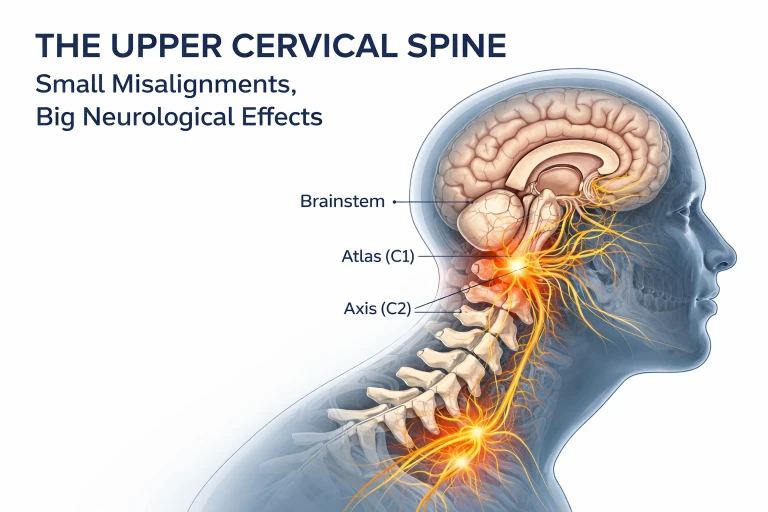
The upper cervical spine is one of the most important and most overlooked regions of the human body. Made up of the atlas (C1) and axis (C2), this small section at the top of the neck has a major job: supporting the head, protecting the brainstem, and allowing precise movement in multiple directions.
Because of its close relationship to the central nervous system, even subtle dysfunction in this area can have wide-reaching effects on how the body feels and functions.
When people think about spinal problems, they often imagine large injuries, severe degeneration, or obvious structural damage. But in the upper cervical spine, very small changes in alignment, motion, or joint mechanics can matter a great deal. That is because this region is not just another part of the neck. It is the transition point between the brain and the rest of the body.
What makes the upper cervical spine unique?
The atlas and axis are different from the other vertebrae in the spine. They are designed for mobility and precision rather than weight-bearing alone. The atlas supports the skull, while the axis allows much of the head’s rotation. Together, they help position the head over the body and maintain balance between stability and movement.
This region also contains a high concentration of neurological structures and sensory receptors. The brainstem passes through this area, and the surrounding muscles, ligaments, and joints provide constant information to the brain about head position, motion, and balance. This input helps regulate posture, eye coordination, muscle tone, and spatial awareness.
Because of that relationship, dysfunction in the upper cervical spine can create more than local neck discomfort. It can interfere with how the nervous system processes information from the body and responds to it.
Why can a small misalignment have such a large effect?
The phrase “small misalignment” can be misunderstood. It does not necessarily mean a dramatic displacement that shows up clearly to the naked eye. More often, it refers to subtle joint dysfunction, abnormal positioning, restricted motion, or asymmetry that changes the mechanical and neurological environment of the upper neck.
In the upper cervical region, small structural changes can matter because:
1. The area is densely connected to the nervous system
The brainstem sits just above this region, and the spinal cord continues directly below it. The surrounding tissues influence the way the body senses position and movement. When joint mechanics are altered, the sensory information sent to the brain can become distorted.
2. Head position affects the rest of the spine
The head weighs a significant amount, and the body constantly works to keep it balanced over the shoulders. If the atlas or axis is not moving or positioning properly, the body may compensate further down the chain. That can contribute to uneven muscle tension, altered posture, and mechanical stress throughout the neck, shoulders, and back.
3. The upper neck helps regulate reflexes and coordination
This area plays a major role in proprioception, the body’s awareness of position in space. It also interacts with systems involved in balance and eye movement. When upper cervical input is disrupted, some people notice not just stiffness, but also headaches, dizziness, visual strain, or a sense that their body is working harder to stay coordinated.
Common symptoms linked to upper cervical dysfunction
Related article

Upper Cervical Chiropractic Near Me: Why Local Precision Care Can Change Everything
Oct 27, 2025Not every symptom comes from the upper cervical spine, and a careful evaluation is always important. But when this area is not functioning well, people may experience patterns such as:
- Neck tension and reduced range of motion
- Headaches, especially at the base of the skull or behind the eyes
- Muscle tightness in the shoulders and upper back
- Dizziness or balance challenges
- Jaw tension
- Postural asymmetry
- A sense of head heaviness or pressure
- Irritation with prolonged desk work or screen time
These symptoms do not always mean there is a major injury. In many cases, they reflect the body trying to compensate for poor mechanics and altered neurological input.
The neurological side of the problem
One of the most important ideas in this discussion is that the body is constantly collecting information and making adjustments. The nervous system depends on accurate signals from joints, muscles, and sensory receptors. The upper cervical spine is one of the most information-rich areas in the body.
When this region is irritated or not moving properly, the brain may receive less accurate feedback. That can influence muscle tone, posture, coordination, and comfort. This helps explain why a small issue in the upper neck may create symptoms that feel larger than expected.
It is not always about compression or dramatic damage. Often, it is about interference with normal signaling and control. A joint that is slightly restricted, inflamed, or positioned poorly can change the way nearby muscles fire and how the body organizes movement.
That is why patients sometimes describe feeling “off” even when imaging does not show anything severe. Their nervous system may be responding to dysfunction that is subtle structurally but meaningful functionally.
How these problems develop
Upper cervical dysfunction can develop from many causes, including:
- Old whiplash injuries
- Repetitive poor posture
- Long hours at a computer
- Falls or sports impacts
- Sleep position issues
- Jaw clenching or stress-related tension
- Previous unresolved neck injuries
Sometimes the triggering event was years ago. The body adapts, compensates, and keeps moving forward, but over time those compensations can build into recurring symptoms.
Why evaluation matters
Because the upper cervical spine can influence both mechanical and neurological function, a thorough assessment is essential. Looking only at pain location is often not enough. A good evaluation should consider posture, head position, range of motion, muscle imbalance, injury history, and how the patient’s symptoms behave during daily activities.

The goal is not simply to identify where it hurts. The goal is to understand why the body is compensating and whether the upper cervical spine is part of that pattern.
What care often focuses on
Care for upper cervical dysfunction depends on the provider, the patient’s needs, and the findings on examination. In general, the focus is often on improving alignment, restoring more normal motion, reducing irritation, and helping the nervous system receive clearer mechanical input.
This may include precise manual care, postural correction, mobility work, strengthening, ergonomic changes, and patient education. The most effective approach is usually not about chasing symptoms one by one. It is about improving how the system functions as a whole.
When the upper cervical spine is working better, patients often notice more than local relief. They may report improved comfort, easier movement, better posture, fewer tension headaches, and a greater sense of physical stability.
Final thoughts
The upper cervical spine may be small, but its influence is significant. Because it sits at the intersection of structure, movement, and neurological control, even minor dysfunction in this region can create effects that seem surprisingly large.
That does not mean every headache or neck problem starts there. But it does mean this area deserves careful attention, especially when symptoms are persistent, recurring, or do not fully respond to more general care.
In many patients, addressing the upper cervical spine is not about treating a tiny problem. It is about recognizing a high-value region where small changes can shape the way the whole body functions.
FAQ: The Upper Cervical Spine
What is the upper cervical spine?
The upper cervical spine refers to the top two vertebrae in the neck, called the atlas (C1) and axis (C2). These vertebrae support the skull, allow head movement, and sit very close to the brainstem and spinal cord.
Can small upper cervical misalignments really cause symptoms?
They can contribute to symptoms when they affect joint motion, muscle balance, posture, and the quality of sensory input going to the nervous system. The effects are often functional and cumulative rather than dramatic.
What symptoms are associated with upper cervical dysfunction?
Common symptoms may include neck pain, headaches, dizziness, muscle tension, reduced range of motion, jaw tightness, and postural imbalance.
Why is the upper cervical spine so neurologically important?
This region is rich in sensory receptors and sits near the brainstem, making it important for balance, coordination, posture, and the body’s awareness of head position.
How is upper cervical dysfunction evaluated?
Evaluation often includes posture analysis, movement testing, patient history, neurological and musculoskeletal assessment, and sometimes imaging when clinically appropriate.
Leave a comment