

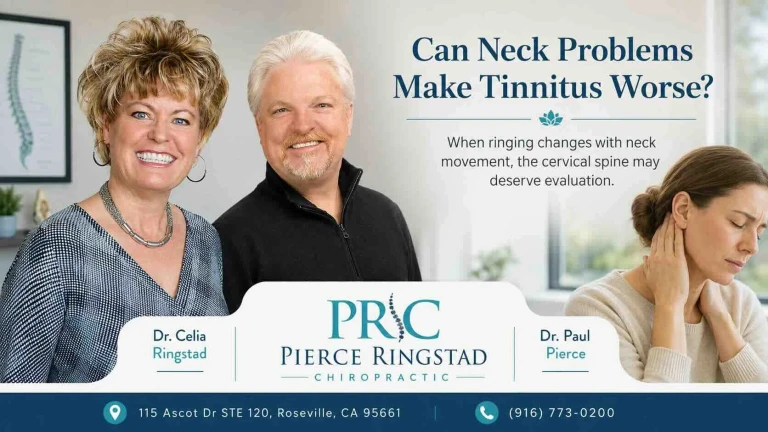
The room is quiet.
Unfortunately, your ears are not.
There is a high-pitched tone in the background. Maybe a buzz. A hiss. Something that seems to follow you from the car to the office and then into bed at night.
Then one day you notice something strange.
You turn your head toward one shoulder and the sound changes.
Not dramatically. Maybe it becomes louder for a few seconds. You straighten your head and it settles again.
Later, you tighten your jaw or press into a stubborn muscle beneath the skull—and the ringing changes again.
When tinnitus reacts to movement elsewhere in the body, the story becomes more interesting.
For some patients, the auditory system may not be working alone.
How the Neck Can Influence Tinnitus
Most tinnitus is associated with the hearing system, but researchers recognize a subtype called somatosensory tinnitus, in which sensory information from areas such as the neck or jaw can influence how tinnitus is perceived.
A 2024 review described cervicogenic somatic tinnitus as tinnitus associated with altered sensory input from the cervical spine. One of the useful clinical clues is whether certain neck positions or movements make the tinnitus louder, quieter, or otherwise different.
That does not mean a cervical misalignment should automatically be blamed whenever someone hears ringing.
The first question remains:
What kind of tinnitus is this, and has an ear-related or medical cause been properly evaluated?
Tinnitus Is a Symptom, Not One Disease
Tinnitus means hearing a sound that does not come from an outside source.
People describe it differently:
- Ringing
- Buzzing
- Hissing
- Humming
- Clicking
- Roaring
For some, it is barely noticeable.
For others, the quietest part of the evening becomes the hardest part of the day.
Hearing loss is one of the most common associations with tinnitus, and ear-related causes should be considered before jumping directly to the neck. Current otolaryngology guidance recommends a hearing test for persistent tinnitus, particularly when it is one-sided or accompanied by hearing loss.
So Where Does the Neck Enter the Picture?
Your nervous system does not process sound inside an isolated little box.
Sensory information from different parts of the body interacts within the brain and brainstem.
The 2024 review on cervicogenic somatic tinnitus discusses communication between sensory signals from the cervical region and auditory-processing pathways. Researchers have proposed that abnormal or persistent somatosensory input from the neck may alter activity in regions involved in tinnitus perception.
The science is still developing.
More importantly, the review is a narrative review, not proof that adjusting the upper cervical spine will eliminate tinnitus.
What it does support is the idea that, in appropriately selected patients, the cervical system deserves attention rather than being dismissed as completely unrelated.
A Pattern Worth Noticing
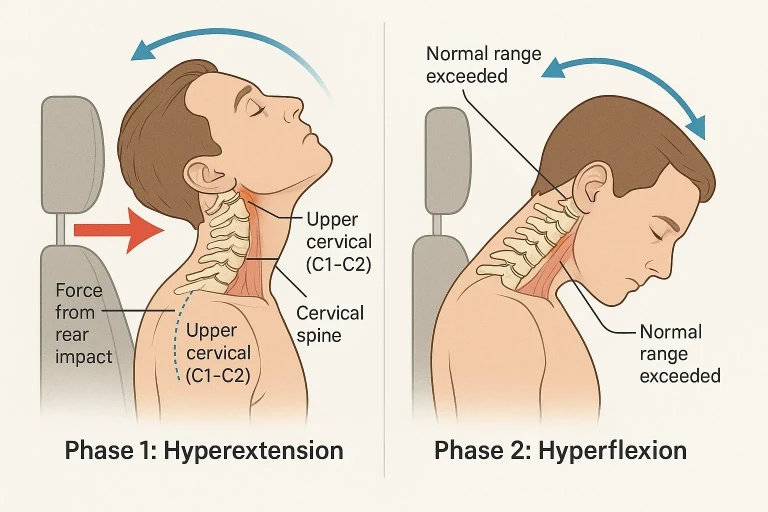
Imagine someone who was rear-ended years ago.
The neck hurt for several weeks and eventually improved.
Months later, ringing developed in one ear.
Maybe those events are unrelated.
But suppose the person also notices that the tinnitus changes when turning the head, working at a computer for several hours, or tightening the muscles beneath the skull.
Now there are several pieces worth investigating together.
Possible clues of a somatosensory component include tinnitus that:
- Changes with neck movement or posture
- Changes when jaw muscles tighten or the mouth moves
- Appeared around the time of a neck or head injury
- Occurs alongside persistent cervical stiffness or muscle tension
No single clue confirms the diagnosis. The pattern is what matters.
What If the Ringing Started After Whiplash?
Whiplash exposes both the head and cervical spine to rapid acceleration and deceleration.
That does not mean whiplash automatically causes tinnitus. Hearing structures, neurological factors, medications, jaw dysfunction, and other problems may also be involved.
Related article
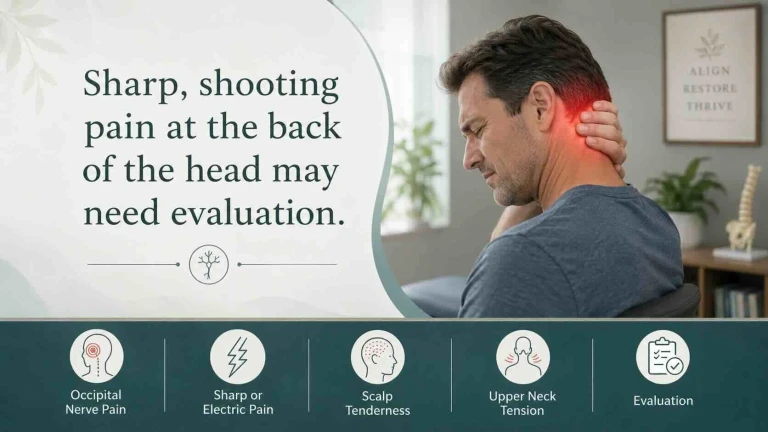
Sharp Pain at the Back of Your Head? Understanding Occipital Neuralgia in Roseville
Aug 05, 2026But when tinnitus begins after trauma and is accompanied by neck symptoms, the cervical history becomes clinically relevant.
At PRC Pierce Ringstad Chiropractic, the doctors emphasize taking a broad health history rather than looking only at the symptom that brought the patient through the door. The practice specifically notes that previous injuries and other events throughout life are considered during evaluation.
That approach makes sense for a symptom as multifactorial as tinnitus.
When Tinnitus Should Be Evaluated Medically First
This section matters.
Some forms of tinnitus need medical or ENT evaluation before considering musculoskeletal care.
Pulsatile tinnitus sounds rhythmic and often follows the heartbeat. The American Academy of Otolaryngology–Head and Neck Surgery notes that pulsatile tinnitus can occasionally be associated with vascular conditions and should be medically evaluated.
Their ear-disease warning guidance, reviewed in 2025, also identifies unilateral tinnitus and pulsatile tinnitus as findings that warrant medical attention. Sudden or rapidly progressive hearing loss and recurring dizziness are additional reasons for referral.
The same applies when tinnitus occurs with significant neurological symptoms.
Upper cervical care should not be used to skip an appropriate hearing or medical workup.
What Does an Upper Cervical Evaluation Look At?
Roseville Blair Chiropractic focuses on the upper cervical spine—the region containing the atlas and axis, or C1 and C2.
Dr. Celia Ringstad and Dr. Paul Pierce use the Blair Upper Cervical method, which is designed around the individual anatomy of the upper cervical joints.
The practice describes the corrections as gentle and specific, without the conventional twisting, popping, or cracking many people associate with chiropractic adjustments. Digital X-rays are used when needed, and thermography is incorporated as part of the office's assessment and monitoring process.
For someone experiencing tinnitus, the purpose of the examination is not to declare, “Your atlas is causing the ringing.”
A more useful question is:
Is there a measurable cervical problem that appears to accompany or influence the patient's symptoms?
The history may include:
- Previous whiplash or head injury
- Neck movement restrictions
- Headaches
- Jaw symptoms
- Whether tinnitus changes with posture
- Whether turning the head changes the pitch or volume
- Previous hearing and ENT testing
That creates a much clearer clinical picture.
Why “Adjust Only When Needed” Matters
One detail of the Roseville practice fits this topic particularly well.
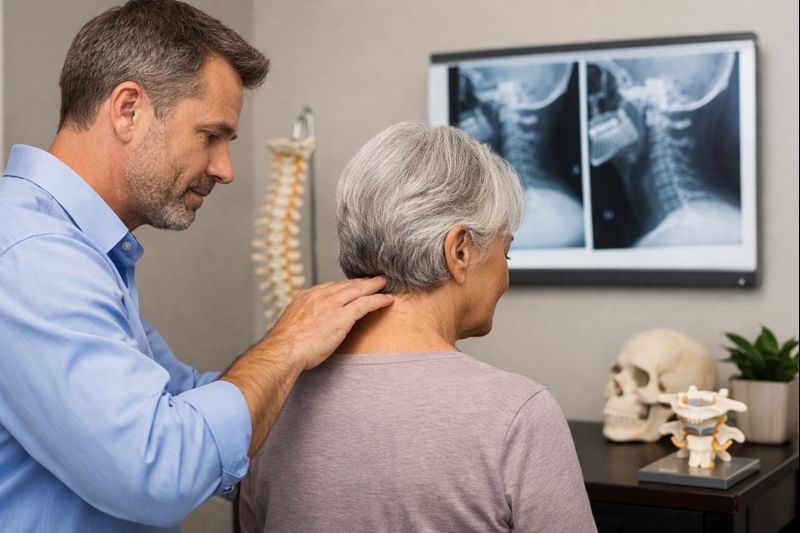
The office states that patients are evaluated to determine whether an adjustment is necessary rather than being automatically adjusted at every visit.
That distinction is important with neurological and sensory symptoms.
More treatment is not automatically better treatment.
The goal should be to identify a relevant mechanical finding, make an appropriate correction when indicated, and then monitor what actually changes.
If tinnitus does not have a cervical component, continuing to treat the neck simply because ringing exists would miss the larger issue.
Frequently Asked Questions
1. Why does my tinnitus get louder when I turn my head?
Some tinnitus is influenced by sensory information from the cervical spine or jaw. When changing neck position repeatedly changes the sound, a somatosensory component may be worth investigating.
2. Can tight neck muscles cause ringing in the ears?
Neck muscle tension and cervical dysfunction have been associated with somatosensory tinnitus, but muscle tightness is not the only possible explanation. Hearing and medical causes should still be considered.
3. Can upper cervical chiropractic cure tinnitus?
Current evidence does not justify promising a cure. Upper cervical care may be relevant when a patient has identifiable cervical dysfunction and tinnitus that appears responsive to neck movement or posture.
4. Should I see an ENT for tinnitus?
Persistent, one-sided, pulsatile, or hearing-loss-associated tinnitus should receive appropriate hearing or medical evaluation.
5. Why did my tinnitus start after an accident?
An accident can affect several systems at once, including the neck, jaw, hearing system, and nervous system. The timing is worth discussing with both medical and musculoskeletal providers, but timing alone does not prove the cause.
Tinnitus and Upper Cervical Evaluation in Roseville
Ringing in the ears can be frustrating partly because nobody else can hear what you hear.
Tests may be normal.
The sound may change from one day to the next.
And when turning your head suddenly changes the pitch, it can leave you wondering whether your ears are really the whole story.
Sometimes they are.
Sometimes the jaw contributes.
And in certain patients, the cervical spine may be another piece worth examining.
At PRC Pierce Ringstad Chiropractic, Dr. Celia Ringstad and Dr. Paul Pierce provide Blair Upper Cervical care with an emphasis on individualized examination, gentle corrections, and adjusting only when the findings indicate that care is needed.
PRC Pierce Ringstad Chiropractic
115 Ascot Dr STE 120
Roseville, CA 95661
Phone: (916) 773-0200
The office serves patients from Roseville, Rocklin, Granite Bay, Lincoln, Citrus Heights, Sacramento, and surrounding Placer County communities.
If your tinnitus changes with head position or began alongside a history of cervical injury, an upper cervical evaluation may help determine whether the neck belongs in the conversation—while appropriate hearing and medical care address the rest of the picture.
Medical note: Tinnitus can have auditory, neurological, medication-related, vascular, musculoskeletal, and other causes. Upper cervical chiropractic should not replace appropriate evaluation by a physician, ENT specialist, or audiologist when indicated.
Leave a comment