


At Roseville Blair Chiropractic, the goal isn't to adjust your neck at every appointment. It's to determine when an adjustment is necessary—and when your body may benefit more from being left alone.
Many people assume that visiting a chiropractor automatically means receiving an adjustment. However, at PRC Pierce Ringstad Chiropractic in Roseville, California, our Blair Upper Cervical approach emphasizes objective testing, careful reassessment, and allowing a correction to remain stable whenever possible.
Understanding why we sometimes choose not to adjust is an important part of understanding our approach to chiropractic care.
What Is Objective Testing in Upper Cervical Chiropractic?
Objective testing involves evaluating measurable physical findings rather than basing every treatment decision solely on symptoms or a predetermined adjustment schedule.
In Blair Upper Cervical Chiropractic, the uppermost vertebrae—the atlas (C1) and axis (C2)—are the primary areas of focus.
Our approach incorporates spinal analysis, clinical findings, and instrumentation to help determine whether an adjustment may be appropriate.
The central principle is simple: An adjustment should be based on current findings, not automatically delivered because a patient has an appointment.
Objective assessment can help guide clinical decisions, although no single test can definitively establish vertebral alignment, nerve interference, or the need for manipulation. Findings should be interpreted alongside symptoms, medical history, examination results, and functional progress.
Why Do We Perform Pre-Checks Before Every Adjustment?
Before deciding whether to adjust, we reassess the patient's current condition.
These pre-checks are intended to help answer three questions:
- Are the findings consistent with those observed before the previous correction?
- Have the clinical indicators changed since the last visit?
- Is another adjustment warranted based on the overall evaluation?
When the findings suggest that the previous correction is holding and the patient is progressing appropriately, we may decide that no adjustment is needed.
This does not mean the appointment was unnecessary.
A visit without an adjustment can provide useful information about stability, recovery, and the patient's response to previous care.
It also supports a more individualized treatment approach rather than assuming every visit requires another intervention.

Why Are Post-Checks Important After an Adjustment?
When an adjustment is performed, our evaluation does not simply end when the procedure is complete.
Post-checks help assess whether selected findings have changed following the correction.
Comparing pre-adjustment and post-adjustment observations provides information that can guide subsequent decisions.
For example, a chiropractor may reassess the clinical indicators that were relevant before treatment to determine whether there has been an observable response.
Importantly, an immediate change in a measurement does not automatically establish long-term clinical improvement. Sustained progress should also be evaluated through patient-reported symptoms, mobility, daily functioning, and appropriate follow-up assessments.
The objective is not merely to perform an adjustment, but to evaluate the response to it.
What Does It Mean When an Upper Cervical Correction Is Holding?
In Blair Upper Cervical terminology, a correction is considered to be "holding" when follow-up findings remain consistent with the intended response to an earlier adjustment.
When this occurs, our approach generally favors continued observation rather than automatically repeating the correction.
The goal is to maintain a favorable clinical response for as long as possible.
This philosophy emphasizes consistency and reassessment rather than the number of adjustments performed.
However, the term "holding" describes a clinical interpretation. It should not be confused with proof that vertebrae are permanently repositioned or that injured ligaments have fully healed.
At Roseville Blair Chiropractic, we believe that knowing when not to adjust is an essential part of delivering thoughtful, conservative care.
How Does Ligament Healing Relate to Chiropractic Care?
Ligaments are connective tissues that help stabilize joints, including those in the upper cervical spine.
When a ligament is injured, its healing process typically progresses through three overlapping biological phases.
Related article

Upper Cervical Chiropractic Near Me: Why Local Precision Care Can Change Everything
Oct 27, 2025Phase 1: Inflammation — The First Several Days
Immediately after ligament injury, the body initiates an inflammatory response.
Immune cells begin clearing damaged tissue, while biological signals activate the repair process.
Although inflammation can cause discomfort and swelling, it is also part of the normal healing response.
Phase 2: Proliferation — The Following Weeks
During the proliferative phase, specialized cells called fibroblasts produce new collagen and other components of the healing tissue.
Early repair tissue contains substantial amounts of type III collagen, which is generally less organized and mechanically weaker than mature ligament tissue.
During this stage, recovering tissues may remain vulnerable to excessive mechanical stress.
Phase 3: Remodeling — Months to a Year or Longer
During remodeling, collagen fibers become increasingly organized.
Type III collagen is gradually remodeled as the tissue develops a greater proportion of stronger type I collagen.
This maturation process may continue for many months or longer, depending on the ligament, severity of injury, and individual circumstances.
Healing does not always restore a ligament to its original mechanical properties.
These biological principles illustrate why treatment decisions should account for tissue recovery. They do not, however, prove that repeated chiropractic adjustments prevent ligament healing or that an upper cervical correction directly accelerates collagen remodeling.
Why Might Fewer Adjustments Be Appropriate?
More treatment is not necessarily better treatment.
If a patient is improving, clinical findings are stable, and another adjustment is not indicated, observation may be preferable to additional manipulation.
This approach is consistent with the broader principle of avoiding unnecessary interventions.
It is particularly important when evaluating patients with a history of neck injury, where treatment should account for tissue condition, clinical risks, and individual tolerance.
At the same time, appropriate movement, rehabilitation, and graded activity may be important parts of musculoskeletal recovery.
Related article
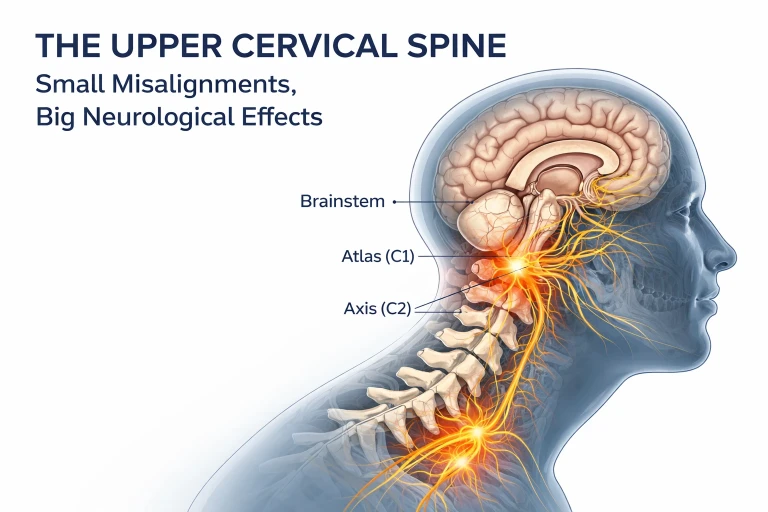
The Upper Cervical Spine: Why Small Misalignments Create Big Neurological Effects
Mar 12, 2026The goal is not to eliminate all mechanical stress, but to select interventions according to clinical need.
How Is Blair Upper Cervical Chiropractic Different?
Blair Upper Cervical Chiropractic focuses on individualized assessment and gentle adjustments directed at the upper neck.
At PRC Pierce Ringstad Chiropractic, Dr. Celia Ringstad and Dr. Paul Pierce use this approach without the twisting or cracking commonly associated with some other cervical manipulation techniques.
Our care philosophy emphasizes evaluating the patient's condition, determining whether an adjustment is appropriate, and reassessing the response.
Blair is a specialized chiropractic technique, and evidence regarding its comparative effectiveness remains limited. Patients should understand the expected benefits, uncertainties, and risks when considering any cervical treatment.
Frequently Asked Questions
Should I Get a Chiropractic Adjustment at Every Visit?
Not necessarily. Whether an adjustment is appropriate should depend on current clinical findings, symptoms, functional progress, and treatment goals—not solely on a recurring schedule.
What Happens if I Don't Need an Adjustment?
Your chiropractor may review the examination findings, monitor your progress, and recommend continued observation or other appropriate care. A visit without an adjustment can still contribute to clinical decision-making.
How Long Does an Upper Cervical Correction Hold?
There is no universal timeframe. The duration of a favorable response varies according to the individual, their condition, and their response to treatment. Follow-up assessments help determine whether further care is warranted.
Can Ligaments Take a Year to Heal?
Yes. Ligament remodeling can continue for a year or longer after some injuries. However, recovery timelines vary, and the healing process cannot be determined from upper cervical testing alone.
Upper Cervical Chiropractic Care in Roseville, CA
At Roseville Blair Chiropractic, we believe an important part of responsible care is knowing when an adjustment may help—and when another adjustment may not be necessary.
Our emphasis on objective pre-checks, post-checks, individualized decision-making, and monitoring a correction reflects that philosophy.
If you're looking for a Blair Upper Cervical chiropractor in Roseville, California, contact PRC Pierce Ringstad Chiropractic to learn more about our assessment process and whether this approach may be appropriate for you.
PRC Pierce Ringstad Chiropractic – Roseville Blair Chiropractic
115 Ascot Dr, Suite 120, Roseville, CA 95661
Phone: (916) 773-0200
Website: https://rosevilleblairchiro.com
Leave a comment